
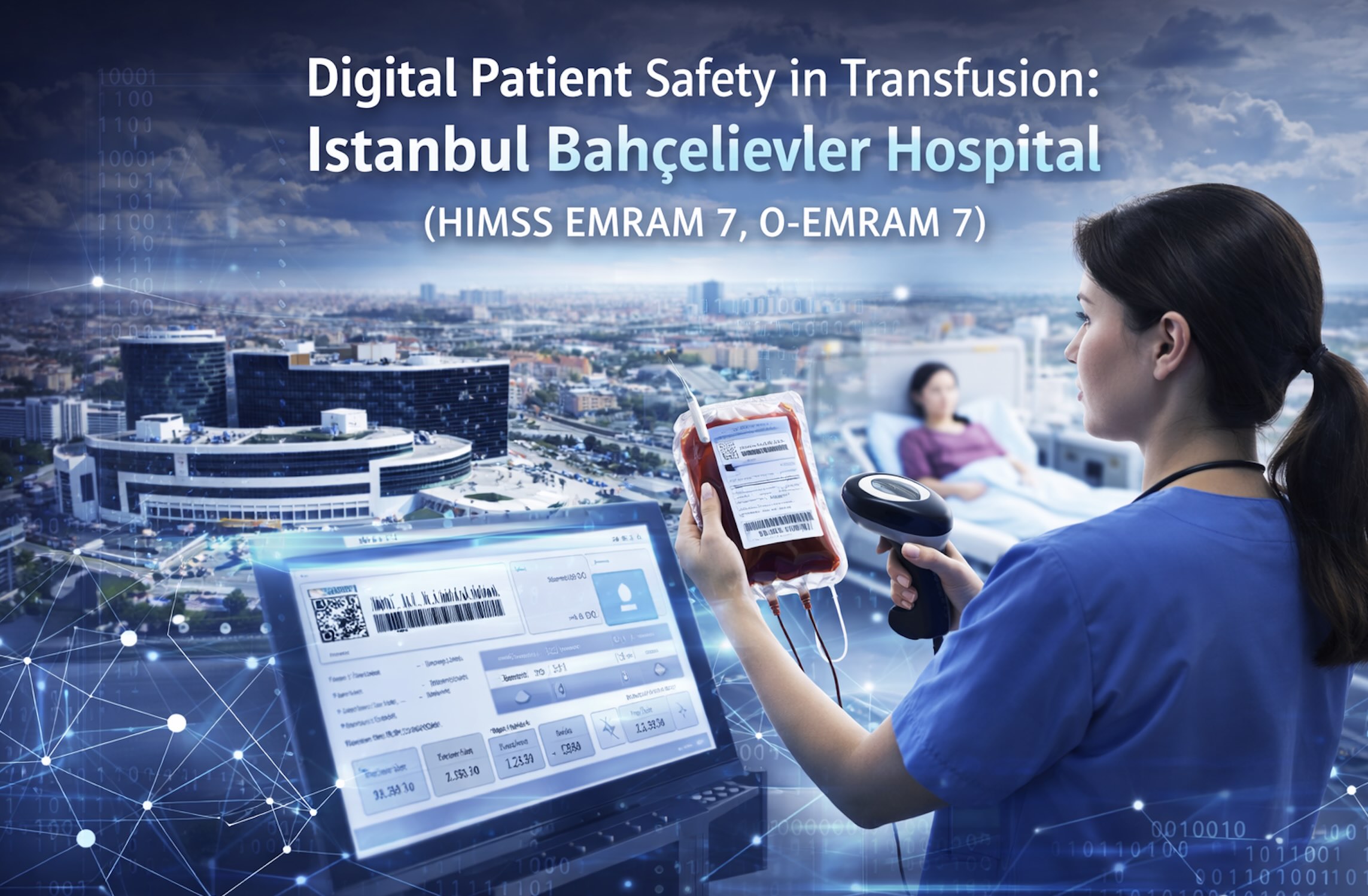
Blood transfusion remains one of the most safety-critical clinical processes in hospital care :
At Istanbul Bahçelievler Hospital, this challenge is addressed through a closed-loop blood transfusion model built on advanced digital integration and strict verification principles, aligned with the hospital’s HIMSS EMRAM Stage 7 and O-EMRAM Stage 7 digital maturity.
In this model, the transfusion process is not treated as a single clinical act but as a continuously controlled digital workflow. The journey begins with the physician’s electronic blood product request, which is securely recorded within the hospital information system and becomes the reference point for all subsequent actions. From this moment onward, every step is digitally linked to the patient and monitored through system-enforced rules.
Blood samples collected for cross-match testing are uniquely barcoded and electronically associated with the patient, eliminating ambiguity during laboratory and transfusion unit operations. Once compatibility is confirmed, the approved blood product is labeled with a patient-specific barcode, ensuring that the product cannot be misassigned or released outside of its intended clinical context.
Within the blood transfusion unit, barcode scanning and system validation confirm product suitability before release. If any incompatibility or deviation is detected—such as blood group mismatch or missing confirmation—the system automatically generates warnings and blocks progression, preventing unsafe transfusion scenarios before they reach the bedside.
Time control represents another critical safety layer within the closed-loop approach.
The system monitors the interval between blood release and administration, enforcing predefined safety thresholds. If these thresholds are exceeded, transfusion initiation is automatically restricted, ensuring that blood products are administered only under safe conditions.
At the point of care, final verification is performed using a mobile transfusion application. Patient wristband barcodes and blood bag barcodes are scanned together, digitally confirming identity and compatibility before transfusion can begin. This bedside verification closes the loop, ensuring that all upstream controls remain valid at the moment of administration.
Supporting this workflow, medical devices integrated with the hospital information system continuously transmit vital signs and patient status data, enabling clinical teams to monitor patient condition throughout the transfusion process. This integration enhances situational awareness and strengthens clinical decision-making without adding manual documentation burden.
The result is a transfusion process that is fully traceable, auditable, and resistant to human error, even in high-volume hospital environments. By embedding patient safety into every digital checkpoint, Istanbul Bahçelievler Hospital demonstrates how advanced digital health infrastructure can transform one of healthcare’s highest-risk workflows into a controlled, transparent, and reliable clinical operation.
This closed-loop transfusion model stands as a strong example of how HIMSS EMRAM Stage 7 and O-EMRAM Stage 7 maturity can move beyond technology adoption and deliver tangible, life-critical safety outcomes in daily clinical practice.